Table of contents
The Significance of the Concept Planning Phase
Summary: Securing the “Quality of Investment” Where Two Dynamics Intersect
Designing the Tasks of the Concept Planning Phase
1. Confirming Management and Business Direction: Decoding Executives’ “Unspoken Expectations”
3. Organizing Root Causes and Defining the Direction of Reform
4. Outline Business Process Design and Outline System Requirements Organization
5. ROI Estimation, Structure Organization, and Schedule Planning: Ensuring Feasibility
Confirming Management and Business Direction: How to Draw Out Executives’ True Intentions
Executive Hearings Leveraging an Outside Perspective
Thorough Preparation: Hypotheses and the Landing Point
Organizing Statements and Points to Note in Handling Them
Organizing Field Issues (Operations): How to Sort Out Issues Scattered Across the Field
Leveraging the Existing “Issue List” as an Asset
Plotting Against Reform Themes: “Synchronizing” Management and Field Issues
Handling Remaining Issues and New Management Issues
Current State Analysis (Operations and Systems)
Grasping the Overall Business Picture and “People and Organization”
Reading Business Flows and Building “Hypotheses”
The Crux of the Hearing: Selecting Interview Subjects
Analysis That Reaches the “Depths” of the System
Discovering Data Discontinuities and “Minor Inconsistencies”
Best Practice as a “Yardstick”
Peer Case Research and Benchmarking
Thoroughly Researching Unexplored Territory and Leading Overseas Companies
Leveraging and Deepening the “Information Market”
Selecting Target Companies and Concentrating Resources
The Benchmarking Trap and Input from a “Big-Picture” View
Organizing Root Causes: Connecting Scattered Issues Along a Single Thread of “Root Cause”
Multiple Perspectives Through Frameworks
Where Root Causes Converge: Systems, Management, and Mindset
The Significance of the Concept Planning Phase
In the introduction of large-scale ERP systems such as SAP, the concept planning (grand design) phase is not merely a preparatory step. Think of it as the process of building the “strategic consensus” needed to maximize the return on investment for the entire project and minimize execution risk.
In this article, we organize the practical significance of this phase from the perspective of two different dynamics: the IT department of the business company, and the external consulting firm.
1. The Perspective of the Business Company (IT Department): Ensuring Decision-Making Quality and Organizational Resilience
For the IT department of a business company, the concept planning phase is a unique opportunity to obtain “approval for the optimal allocation of management resources.” At many Japanese companies, two structural issues lie behind why this phase becomes a mere formality or runs into difficulty.
Commitment by Management to “Discontinuous Change”
Renewing an ERP system is not merely an update to IT infrastructure; it is a management-level transformation that involves redesigning business processes. However, for many executives, ERP falls outside their area of expertise, and they often find themselves unable to make the final decision (investment approval) for an investment of hundreds of millions to billions of yen unless they have confidence in the ROI — in other words, “what will we actually get out of this.” The role of the IT department is not to explain system functions, but to define, in the language of management, the business value realized through the implementation — such as “more sophisticated management control” or “supply chain visibility” — and thereby draw out a “yes” from the executive team. If consensus at this phase is insufficient, the project will inevitably risk having the ladder pulled out from under it by management midway through.
Gaining the “Legitimacy” to Break Field Conventions
The essence of an SAP implementation lies in “Fit to Standard” — conforming to standard functionality. This means rejecting the “company-specific business processes” that the field has cultivated over many years, and aligning instead with global standards. Naturally, resistance from field departments is unavoidable. Securing agreement with management, during the concept planning phase, on a high-level principle such as “standard functionality as the default” means securing the “legitimacy of governance” needed to later reject the individual demands from the field that will inevitably surface during the requirements definition phase — making this an extremely important process.
2. The Perspective of the External Consulting Firm: Establishing Project Governance and Eliminating Risk
For a consulting firm, the concept planning phase represents the first major hurdle toward the reform that follows.
Clarifying Executive Authority Through Alignment with Executives
What professional consultants focus on most during this phase is not refining documentation, but clarifying the business as envisioned by the client’s management team and helping them understand the data strategy the company needs but cannot yet articulate. In concept planning, what matters most is confirming the company’s direction together with management, agreeing on what this initiative will mean for the company going forward, and securing their cooperation.
Blocking “Rework Costs” by Defining Scope
In addition, the technical significance of the concept planning phase lies in fixing the broad outline of the system architecture and defining the boundaries (scope) of the project. Any change of direction that occurs after the requirements definition phase carries an exponentially higher correction cost compared to a change made during the concept planning stage. Based on their professional expertise, consulting firms must proactively identify risks that could arise in the future and secure management decisions on them during this phase.
Summary: Securing the “Quality of Investment” Where Two Dynamics Intersect
In conclusion, the concept planning phase is a highly political and logical process in which the business company resolves its “determination to transform,” and the consulting firm translates that transformation into an “executable plan.”
Management approves the investment with genuine conviction, and the consultant uses that approval as a shield to govern the field. Unless this robust cooperative relationship is built, a large-scale organizational transformation such as an SAP implementation will not succeed. For this reason, investing sufficient resources in the concept planning phase is arguably the most efficient form of risk management, and the shortest path to maximizing return on investment.
Designing the Tasks of the Concept Planning Phase
It is now widely known that, in large-scale business transformation and system renewal, 80% of success or failure is determined not at go-live, but during this “concept planning phase.” Yet looking at a variety of recent projects, we see a number of cases where this phase is treated too lightly. For this reason, we begin by explaining how tasks should be designed within the concept planning process.
First, concept planning is not simply a matter of listing functional requirements. It is nothing less than a “decision” that translates management’s intent — how the company will “fight and win” in the market five or ten years from now — into concrete system architecture and operations.
Below, we describe in detail the essential approach to each task along the attached roadmap, along with the strategic intent behind it.
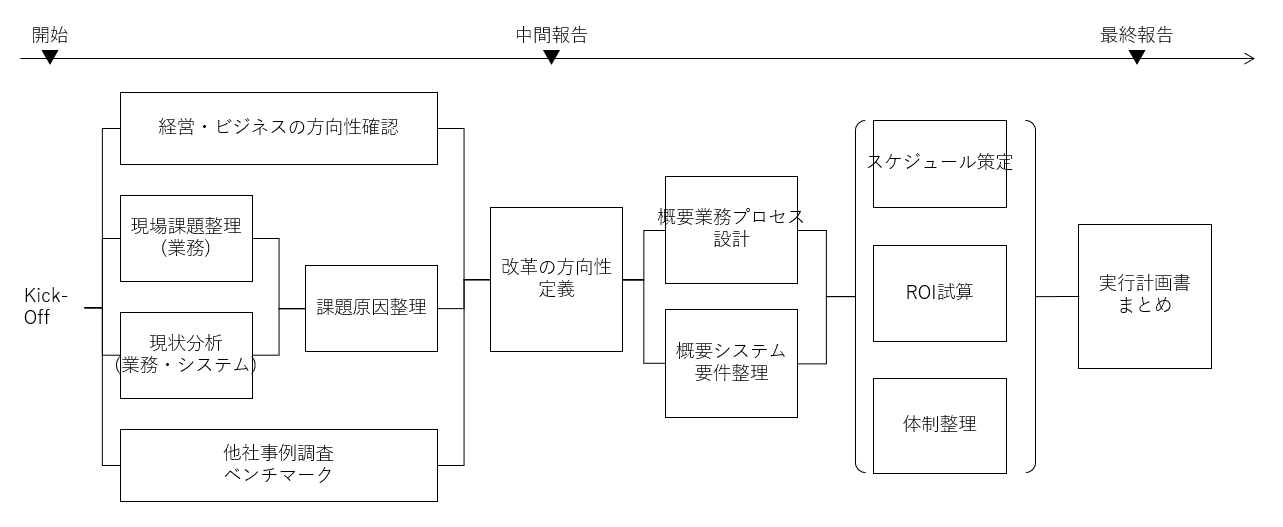
1. Confirming Management and Business Direction: Decoding Executives’ “Unspoken Expectations”
The most important stakeholder in this project is the management team that makes the final investment decision. However, a trap that many projects fall into is picking up only the surface-level words management uses, such as “cost reduction” or “efficiency improvement.”
What executives truly want is often hidden beneath the surface of their words. It exists at an extremely strategic level — things like “reorganizing existing businesses,” “building new business models,” or “reshaping the corporate culture,” all through digital means. Consultants and project offices must, through dialogue with management, bring these “latent needs” to the surface.
Furthermore, a system renewal takes several years to complete. Building a system based on today’s standards carries the risk that it will already be a “relic of the past” by the time it goes live. For this reason, this task must unpack “how the business will change in the future” by drawing on advanced examples from other companies and global benchmarks. What digital weapons will competitors have, and how will customer expectations have changed, in the market environment five years from now? By backcasting from that future picture, we define the system that should be built today.
2. Organizing Field Issues and Current-State Analysis: Elevating the Field’s “Pain” into Management’s “Solution”
At the same time, it is the people on the ground who actually operate the system. A project that fails to win their cooperation is bound to fail. Countless “problems and issues” accumulate in day-to-day operations on the front lines. It is important to pick each of these up carefully, one by one, rather than dismissing them as mere “complaints.”
The key point here is not to treat the field’s troubles as isolated issues, but to depict a scenario in which they “disappear together with” the major initiatives championed by management. For example, if management wants “global inventory optimization,” you show that this is the very solution that reduces the field’s “daily burden of tedious inventory reconciliation” to zero.
Giving the field the conviction that its individual inconveniences will be “structurally resolved” through the standardization and sophistication that management is pursuing — this is the only way to generate the powerful driving force (buy-in) behind transformation.
3. Organizing Root Causes and Defining the Direction of Reform
Once “field issues” and the “current state of the system” are both laid out, what should follow is not the presentation of symptomatic improvement measures. It is identifying the “root cause” of why the problem is occurring in the first place.
In many cases, the problem is rooted not so much in the system itself as in “inefficient business processes” and “sectionalism between organizations” that have accumulated over many years. In defining the direction of reform, it is essential to step into these organizational sanctuaries.
On top of that, these must be crystallized into a handful of “key reform themes” that maximize business impact. Themes are set that connect directly to management strategy, such as “achieving full visibility of the global supply chain” or “introducing real-time management accounting.”
What matters is bringing these themes and proposed directions for resolution to management at this stage, and explicitly asking for their “endorsement of direction (buy-in).” This is because, from here on, the project will step into business rules, authority, and even the shape of the organization itself — and without strong management support, it will be impossible to overcome the “status quo bias of the field” that will inevitably surface later. Obtaining, at this stage, a firm agreement from management that “we have decided to invest for the sake of this theme” is the lifeline of the project.
4. Outline Business Process Design and Outline System Requirements Organization
Distinguishing the “Desired Future State” from the “Points of Change” at the Business Overview Level
After obtaining approval from management, the work moves on to concrete business design. Here, before getting buried in detailed clerical procedures, the “desired future state (To-Be)” is first redefined at the business overview level.
At this point, what a consultant must focus on most is thoroughly visualizing the “points of change” between the current state (As-Is) and the desired future state.
“Which existing tasks will disappear?”
“Which decision criteria will change?”
“How will operations on the ground be simplified?”
By concretely presenting these points of change, field members can actually feel “how their way of working will improve,” while at the same time the psychological hurdles that come with transformation can be resolved in advance.
Translating This into System Requirements and Pursuing “Simplicity”
Based on the redefined business processes, the work is finally translated into concrete system requirements. The design philosophy here must consistently be the “pursuit of simplicity.”
As noted earlier, the more systems are connected together, the more interface costs soar and the more future strategic flexibility is impaired. When organizing system requirements, we must constantly ask ourselves: “Could this function be replaced simply by making a small adjustment to the ERP’s standard process?” and “Does this data integration truly need to happen in real time?”
Carefully select the requirements that are truly indispensable for realizing the “desired future state” of the business, and shift as many functions as possible toward the core of the ERP. It is this thorough spirit of “Fit to Standard” that makes possible the true objective the project seeks to achieve — namely, building a “management foundation resilient to change.”
The “outline system requirements” produced through this process are not merely a list of functions. They become a highly strategic blueprint for realizing, with the minimum possible technical debt, both the “direction” set out by management and the “points of change” accepted by the field.
5. ROI Estimation, Structure Organization, and Schedule Planning: Ensuring Feasibility
As a final step, the discussions to this point are translated into quantitative figures and an executable plan.
ROI estimation: Rather than simply comparing license fees or development costs, we calculate the true return on investment, including the added value generated by business transformation and the future cost avoidance achieved by reducing interfaces.
Structure organization: The project does not “belong to the IT department.” A governance structure is built in which the business side holds ownership and top-down decisions can be made swiftly.
Schedule planning: Over the long haul of five years, milestones are strategically placed to prevent the project from losing momentum midway.
Conclusion: Compiling the Execution Plan
The final deliverable — the “execution plan” — must give management “conviction in the investment,” give the field “hope for the future,” and give the development team “an unwavering guidepost.”
The concept planning phase is not a period for producing plans on paper. It is a process of focusing the energy of the entire organization onto a single point aimed at the shape of the company five years from now. Exhaustively debating every issue during this phase, and forging a strong consensus of “this is the path we will take” in the face of an uncertain future — this is the very significance of the concept planning phase.
In what follows, we explain the concrete approach for each individual task.
Confirming Management and Business Direction: How to Draw Out Executives’ True Intentions
Leading this project to success requires strong commitment from management. Because system renewal involves substantial investment and organizational change, if management does not hold the conviction that “this investment is necessary for the future we want,” their footing will waver the moment difficulties arise. For this reason, accurately grasping what management wants at the very outset of concept planning, and reflecting it in the initiatives that follow, forms the foundation for everything else.
Executive Hearings Leveraging an Outside Perspective
The most effective way to probe management’s true intentions is direct dialogue — that is, hearings. What matters here is that it is deliberately an outside consultant or expert, rather than an in-house staff member, who listens to the “raw voice.”
When an in-house person conducts the hearing, executives often feel irritation — thinking “I’m sure I’ve said this before” or “why isn’t something we already understand being put into action?” When an outsider poses the questions afresh, from an objective standpoint, management becomes able to reorganize and articulate not just their current dissatisfaction, but also a “sense of crisis about the future” and a vision of “how things truly ought to be” that they normally do not put into words.
Four Key Items in the Hearing
Rather than being conducted aimlessly, hearings are generally carried out around the following four pillars.
Current state of the area of responsibility: What is the current situation in the organization the executive oversees?
Data utilization and company-wide issues: From the standpoint of data analysis and utilization, what do they feel is a barrier company-wide?
Forward-looking issues: What do they predict will become a critical issue in the business environment three or five years from now?
Current and future initiatives: What initiatives are they currently focused on, and what plans do they hope to undertake in the future?
Examples of Failed Hearings and the Weight of “Listening”
The biggest failure pattern in hearings is when the listener tries to show off their own knowledge, or rushes to present a solution.
A failure example: In one project, the listener interrupted the executive and rushed to give technical answers such as “that’s a functional gap in the current ERP” or “the latest AI would solve that.” As a result, the executive closed up, thinking “I don’t want to hear about the fine details of the field,” and it became impossible to draw out the “strategic management concerns” that should have been surfaced.
The key lies in listening to the other person deeply and carefully — active listening. There is value in the very process of getting the executive to put their “vague anxieties” and “expectations” into words.
Thorough Preparation: Hypotheses and the Landing Point
To make dialogue with management meaningful, the listener cannot afford to go in with a “blank slate.” It is essential to prepare, in advance, some sense of where the conversation should “land.”
Concretely, this means thoroughly studying externally available information such as securities reports, along with internal medium-term management plan documents, and forming hypotheses about the issues in advance. In particular, the following themes, which are common across today’s business environment, should always be kept in mind.
-
Labor shortages: The need for automation and labor-saving in operations amid a shrinking working-age population.
-
Sustainable SCM: Ensuring supply chain transparency and continuity.
-
Global optimization: Optimizing inventory on a global scale and minimizing lost opportunities.
-
Business model transformation: Shifting from “selling products” to “selling experiences (servitization).”
-
Growth strategy: A flexible, easily integrated system foundation with an eye toward M&A.
In the hearing itself, the interviewer is expected to draw out the executive’s awareness of issues related to these keywords, and guide the dialogue so that it connects to the context of “why can’t this be achieved with the current system” and “how would renewing the system solve it.”
Organizing Statements and Points to Note in Handling Them
The results of the hearings are concisely summarized, roughly one PowerPoint slide per executive. It is important, in doing so, to highlight the keywords related to the reform themes that will be discussed in later phases, so as to make visible how the executive’s words connect to system requirements.
That said, extreme care is required in handling this material. Because the executive’s “raw voice” can include sensitive issues between organizations or matters related to personnel, disclosing it carelessly within the company risks causing unnecessary confusion or trouble. The extent to which this summarized material is shared must always be discussed in advance with the project management office, and decided with great care.
In this way, the work of carefully picking up on management’s intentions and converting them into strategic keywords is precisely the process that breathes the “soul of management” into the system renewal.
Organizing Field Issues (Operations): How to Sort Out Issues Scattered Across the Field
To accomplish large-scale transformation, cooperation from the field is an indispensable element. If management’s ideals alone are unilaterally imposed, the field will push back — “we’re already stretched thin with our daily work, and now more is being added?” — and the project will become hollow. At the same time, each member of management strongly wants issues within their own area of responsibility to be resolved. Caught between these two pressures, drawing up a scenario in which “both sides’ issues are resolved simultaneously” is where the true skill of concept planning is put on display.
Leveraging the Existing “Issue List” as an Asset
In many cases, the field of a business company already has an “issue list,” accumulated in Excel or similar form through past improvement projects and daily operational reports. Work begins by carefully collecting and unpacking these. Not ignoring the “pain” that the field has carried for years, and showing a willingness to take it all in at least once, is the first step in building a relationship of trust.
The Wall of Mismatched “Granularity” and “Vocabulary” in Issues
When organizing the collected issues, one inevitably encounters inconsistent levels of granularity and non-uniform expression. The voices raised from the field are often extremely specific and fragmentary, and cannot be brought into strategic discussion as they are.
Below are examples of commonly seen issues.
Difference in granularity: An abstract issue such as “inventory accuracy is low” is mixed together with a concrete task such as “entering the inventory count sheet for Warehouse A is tedious.”
-
Inconsistent terminology: The same event is described with different words — for example, one department calls it “order receipt” while another calls it “deal closing.”
-
Subjective complaints: Sensory grievances whose cause has not been identified, such as “the current system is slow” or “the screen is hard to use.”
-
Normalization of manual workarounds: Stories of workarounds (hardships) outside the system, such as “we can’t create the report unless we export a CSV and process it in Excel.”
-
Complaints about tasks being tied to specific individuals: “We can’t find out where this data came from unless we ask Mr./Ms. So-and-so.”
-
Ambiguous boundaries of responsibility: “Because sales doesn’t enter the data, accounting has to make corrections.”
-
Occurrence of duplicate management: “There are three ledgers, and we can’t be sure which one is the latest.”
-
Bloating of exception handling: “Only Company A requires a special calculation, and the system doesn’t support it.”
-
Timing gaps: “We can’t see last month’s figures until the monthly close is finished.”
-
Breakdown of information flow: “We placed the order, but we can’t track where the shipment is now.”
Plotting Against Reform Themes: “Synchronizing” Management and Field Issues
To resolve these issues of varying granularity, they must be matched against the “reform themes” derived from the hearings with management.
Concretely, a matrix is created in Excel with “reform themes” along the vertical axis and “field issues” along the horizontal axis, and each issue is plotted (linked) accordingly.
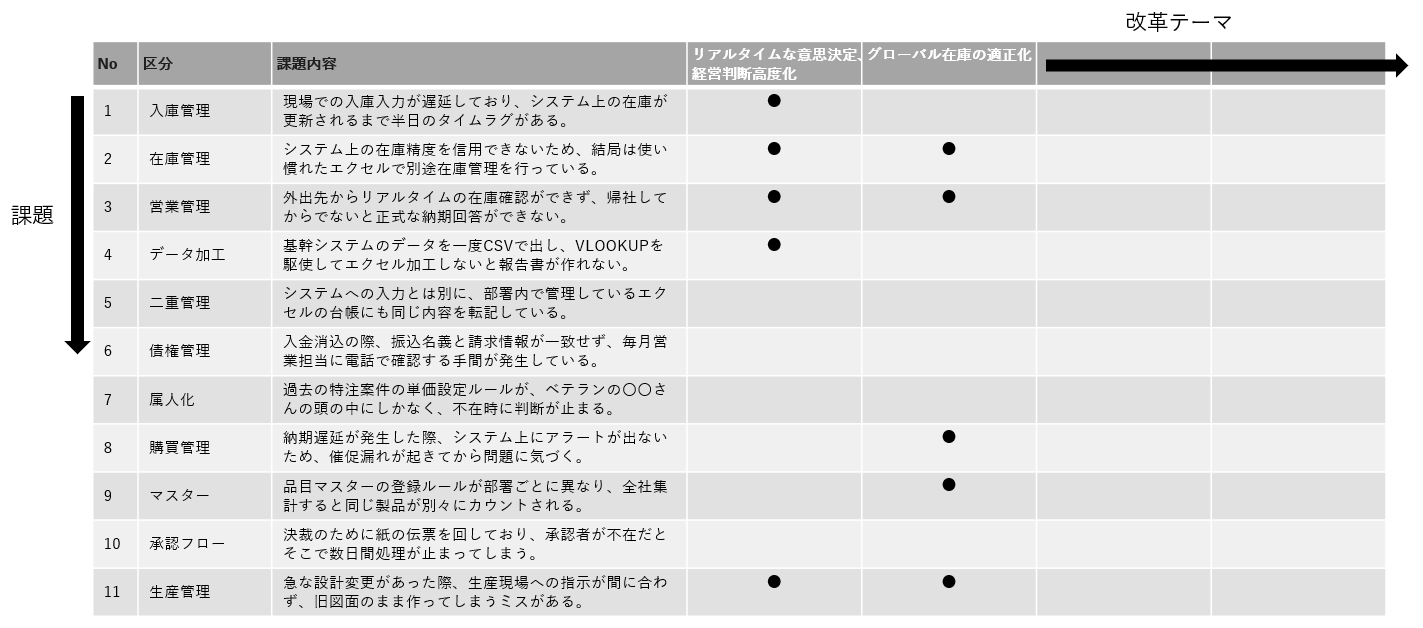
As the work actually proceeds, it becomes apparent that the large theme management has in mind, “optimizing global inventory,” and the issues the field is struggling with — “delays in inbound-receipt data entry” or “managing inventory in Excel” — in fact share the same root. Although expressed differently, executives’ ideals and the field’s concerns are often really the same phenomenon viewed from different angles.
By making visible how field issues will be “structurally resolved” through management initiatives, most field issues can be placed within the context of the transformation.
Handling Remaining Issues and New Management Issues
However, a certain number of issues may remain that cannot be linked to any theme. For these, one of the following two judgments must be made.
-
Reorganize as a new subcommittee or theme: Important issues that fall within the scope of the renewal project but were not fully covered by the initial themes (for example, responding to a specific regulation).
-
Separate out as a management issue: Based on experience, some of these — such as “dissatisfaction with the organization’s evaluation system” or “lack of communication between departments” — cannot be resolved through system renewal, or clearly fall outside the scope of the project.
It is important not to force these to be resolved through the system, but instead to present them separately as “management issues” that need to be addressed. To keep the system renewal from becoming a catch-all “handyman” and to let it function purely as a weapon for business transformation, this work of “sorting” is precisely what constitutes sound judgment in concept planning.
Current State Analysis (Operations and Systems)
Current State Analysis (Operations and Systems): The Deep-Dive Process of Assembling “Evidence” for Transformation
Within concept planning, current-state analysis is one of the tasks that requires the most time and effort. The purpose here is not simply to document “the way things are done now.” It is to deeply understand the characteristics of the business and its products, and to identify the structural factors behind why the current inefficiencies have been allowed to persist.
Grasping the Overall Business Picture and “People and Organization”
First, we survey the overall business picture starting from the characteristics of the target business and products. Is the product mass-produced or made to order? What is the degree of global expansion? The ideal way of conducting operations differs greatly depending on these characteristics.
At this point, document analysis and hearings are used to identify which factories, departments, and “who” specifically are involved. Grasping not just formal roles on the organization chart, but also the departments and key people who function as the real hubs of information, becomes extremely important for building consensus later on.
Reading Business Flows and Building “Hypotheses”
If existing business flow diagrams already exist, they are studied thoroughly before the hearings. However, simply tracing the flow of arrows is not enough.
Screens used: Which screen of which system is being operated.
Data being managed: What are the input fields, and which data is carried forward to subsequent processes.
Functions: Whether the system calculates automatically, or a person makes the judgment.
In the process of reading through these, hypotheses about issues are formed — “isn’t this data discontinuity what’s giving rise to Excel-based management?” or “isn’t this duplicate data entry a burden on the field?” Hearings should be positioned as a “venue for verification,” used to confirm and reinforce these hypotheses.
The Crux of the Hearing: Selecting Interview Subjects
The main subjects of the hearing are “field-level section managers and team leaders” who have a deep grasp of day-to-day operations.
This is because interviewing people at the department-head level tends to stay confined to past memories and idealized statements — “this is how we used to do it” or “this is how it should be” — and the raw reality of the present often fails to come through. What we should deliver to management is not the polished reports of department heads, but the urgent reality of “why the field is struggling” and “why the field remains unable to change its irrational ways.” Linking the minute issues on the ground to the larger issues of management is precisely where our greatest value in concept planning lies.
Analysis That Reaches the “Depths” of the System
In system analysis, we comprehensively grasp the reality not only of visible, large-scale applications (such as ERP) but also of the SaaS tools, Access databases, and even Excel macros that have sprung up organically in the field.
Why do these exist individually, and why do they continue to be used? It is essential not just to receive verbal explanations, but to actually be shown the operating screens and the files themselves. If operation manuals or design documents exist, reading through them can highlight the gap between how the system was originally intended to be used and how it is actually used today.
Discovering Data Discontinuities and “Minor Inconsistencies”
In the process of tracing the flow of data, we identify the phenomena that give rise to the “negative chain” of data discontinuities and re-registration of master data.
In our experience, behind the major issues holding back a company’s growth, one surprisingly often finds a seemingly minor flaw — that the system simply cannot hold just one or two data fields.
Example: A case in which, simply because “the system has no field to register the customer-specified pallet number,” a separate Excel management sheet is created on the ground, an email has to be sent for every delivery, and the result is mis-shipments and lead-time delays.
It is necessary to correctly understand and point out losses of this kind — things that have become taken for granted on the ground, but that represent a critical loss from a management standpoint.
Best Practice as a “Yardstick”
The premise underlying this entire series of tasks is the best-practice perspective of “how things ought to be.”
No matter how much one examines the current state, issues will not become visible without something to compare it against. It is important to correctly grasp the data structures and standard processes of globally standard packages such as SAP. Only by measuring the current state against the “standard” of the package as a yardstick does it become possible to objectively demonstrate just how idiosyncratic and inefficient the current way of doing things really is.
Peer Case Research and Benchmarking
When people hear “peer case research,” many projects tend to stay confined to organizing publicly available information about competitors. However, the client is a professional in their own industry, and they already have some grasp of competitor trends through industry gatherings and their own channels. Simply compiling public information neatly is likely to earn nothing more than “we already know that.” To exceed the client’s expectations and earn genuine professional trust and respect, focus is needed on the following two points.
Thoroughly Researching Unexplored Territory and Leading Overseas Companies
The first is research into business areas that the client “is considering for the future but has not yet touched.” Precedents related to future business models — ones that are not simply an extension of the present — represent the most valuable information for the client.
The second is a thorough investigation of leading overseas companies. It is in global-perspective benchmarking, rather than a narrow domestic view, that a strategy consulting firm demonstrates its true value. In particular, advanced initiatives in Europe, the United States, and emerging markets are areas the client cannot easily reach directly, and expertise here establishes the consultant’s standing as a “teacher.”
Leveraging and Deepening the “Information Market”
Behind the phrase “collecting case studies through internal networks,” the professional world employs a technique of “buying information” from specialized information brokers and expert networks. In this market, accessed at a cost, lies raw information that can never be obtained from public sources — what competitors’ management teams are thinking and what struggles they are grappling with.
In past engagements, we thoroughly pursue answers to questions such as “which core system a target company adopted, for what reasons, and what quantitative and qualitative management benefits resulted.” The true purpose of this research is to grasp the underlying reality — sometimes to a degree bordering on industrial espionage — and to expose the “management intent” that lies behind the system.
Selecting Target Companies and Concentrating Resources
When dealing with a global company operating diversified businesses, selecting the targets of research is extremely important. Japan, the United States, Europe, China, and rapidly growing India — attempting to cover every one of these regions would require an enormous amount of time and resources for interviews and analysis.
But this is precisely an important point in concept planning. Deliberately commit resources and investigate exhaustively. By completing research at a depth that leaves the client surprised — “you went that far?” — trust in the consultant turns into respect, allowing the entire subsequent concept planning phase to proceed to the firm’s advantage.
The Benchmarking Trap and Input from a “Big-Picture” View
Great care is required when presenting benchmarking results. Because the client is also a professional, they will frequently demand consistency in the fine details of the figures and cases presented. However, no company in the world shares exactly the same management environment or exactly the same business model as another.
For this reason, when using benchmarks, it is essential to establish the following premises in advance.
-
Use from a big-picture view: Treat the benchmark as material for reading structural trends and strategic approaches, not for comparing detailed figures.
-
Add the consultant’s judgment: Make clear that this is not merely the presentation of data, but an “interpretation” that the consultant has derived from incomplete information.
A benchmark is, in the end, only a reference figure — it is never complete. What is required is the skilled touch of using it as a spark for discussion, while sharing with the client a goal image of “useful as a reference, but not something to be overly fixated on in detail.”
Building, through this activity, powerful evidence for the argument that “other companies are doing this, and therefore we should do the same” — that is the true mission carried by the task of peer case research.
The “root-cause organization” phase is the process of gathering together scattered facts and identifying the “true source of the affliction” lurking deep within the organization. We describe the approach for giving a logical answer to the “unidentifiable irritation” that executives have felt for years, and for encouraging their resolve to pursue transformation.
Organizing Root Causes: Connecting Scattered Issues Along a Single Thread of “Root Cause”
By the time current-state analysis, organization of field issues, and peer case research are complete, an enormous number of “issue fragments” should have been gathered. The purpose of this phase is to apply thorough “why-why analysis” to these fragments, and to identify the root cause lurking beneath the surface-level events.
Multiple Perspectives Through Frameworks
To raise the precision of the analysis and eliminate blind spots, it is extremely effective to use established frameworks as “auxiliary lines for thought.” Representative frameworks for recapturing the overall picture of an organization are illustrated below.
-
McKinsey 7S: Verifies the alignment not only of the “hard S’s” such as strategy and structure, but also of the “soft S’s” such as shared values and staff.
-
Accenture Six Bubbles: Captures the organization through six elements — business direction, business processes, organization and roles, evaluation and reward, information (IT), and shared values. In particular, examining whether “evaluation and reward” is generating irrational operational conventions is useful for identifying root causes.
-
External environment analysis (Five Forces / 3C): Rather than confining the analysis to internal problems, it examines whether external factors such as intensifying market competition or shifting customer needs are contributing to the limitations of the current system.
Where Root Causes Converge: Systems, Management, and Mindset
As causes are thoroughly dug into, in most cases the root does not lie in peripheral matters such as “the operability of a button,” but converges instead on fundamental elements — the way management operates, the philosophy behind the system, or the mindset of employees.
“Why has Excel-based management become so pervasive in the field?”
“Why is inbound-receipt data entry delayed?”
Repeating these questions eventually leads to fundamental problems: an “organizational culture that does not tolerate standardization,” “management’s leniency in having condoned local optimization by the field,” or a “rigid system foundation unable to keep pace with business change.”
Simply changing the business flow or swapping in the latest system will, within a few years, cause the same problem to recur. True transformation requires stepping in at the level of the organization’s “culture” and “philosophy.”
Turning Executives’ “Haze” into Conviction
Many executives carry a strong, unarticulated frustration about their organization not moving the way they intend. Our job is to connect, with a logical thread, the faint concerns picked up from executives during hearings with the mountain of concrete issues collected from the field.
“The true nature of the sense of organizational stagnation that the president had vaguely sensed actually lies in the ‘black-boxing of information’ caused by this data discontinuity, and at its root is a company culture that has long downplayed data and its use.”
In this way, vividly depicting the structure of a problem that had been shrouded in fog, and delivering the deep sense of conviction — the “Aha” experience — of “so this was the root of all evil.” Through this, what the executive “had vaguely sensed” is transformed into the “firm conviction that this must absolutely be done.”
This “conviction” is precisely the crucial driving force needed to see a difficult, multi-year project through to the very end.
Have a question about this article?
Ask the author directly — no sales pitch, just an answer.